Consulting · Technology · Publishing
Three entities.
One architecture.
A consulting practice, a technology company and a publishing imprint. Each one distinct, each one sharpening the others. Analysis stopping at the page changes nothing, which is why every finding here is built to leave the page and land somewhere a decision gets made.
The Ecosystem
Each entity plays
a specific role.
Azimu Group turns research into institutional strategy leaders can act on. Just Society Technologies builds the infrastructure letting communities produce and hold their own evidence. Covered Suns carries the ancestral and devotional work into print.
Azimu Group, SPC
Azimu: Swahili for accepting a grave undertaking.
Founded in 2011 and structured as a Social Purpose Corporation, Azimu builds the capacity of institutions and governments to navigate the five global shocks threatening state stability and democratic governance.
Clients come to Azimu for a reading of their situation they can actually act on, delivered by somebody who stays through implementation rather than handing over a document and leaving.

Seattle Public Schools · King County · Foundation for Tacoma Students · Open Buffalo · EcoTrust · 4Culture · State of Colorado Outdoor Strategy · Charity and Security Network
Institutional Transformation
Moving organizations from equity statements to operational coherence with measurable accountability.
Policy 0040 and its Superintendent procedures were authored from more than fifty interviews and focus groups, carrying one hundred deliverables with a key performance indicator attached to each. Seattle Public Schools adopted it in 2020. King County, the City of Seattle and Washington State Charter Schools followed.
Strategy and Long-Range Planning
Ten-year plans built on community evidence rather than a leadership retreat.
A ten-year strategic plan at Seattle Public Schools carrying two hundred named deliverables, built on more than seventy-five focus groups across intersectional identities. An organizational diagnostic and change model at TNTP, delivered as training reaching more than six hundred staff.
Measurement and Accountability
Systems showing how much was delivered, how well, and whether anyone is better off.
Countywide application of Results Based Accountability across more than forty contracted programs. Organizational audits at Foundation for Tacoma Students. An anti-racist audit instrument and training curriculum at Open Buffalo.
Global Shock Preparedness
Reading climate, automation, hyper-urbanization, pandemics and wealth inequality before they produce a crisis.
Protective infrastructure is built in advance. Resilience assembled during recovery arrives late by definition, and the cost of arriving late sits in the same budget as the cost of preparing early.
Equitable Resilience Planning
Applying spatial reconciliation to produce plans a jurisdiction can actually implement.
Implementable plans for discharging resilience debt and building community infrastructure across physical, social, economic and institutional dimensions, with named obligors and observable records.
Philanthropic Strategy
Moving foundations beyond grantmaking toward systemic change.
Eleven of more than twenty applications submitted won three-year capacity building grants at $75K per year. The Chartered Advisor in Philanthropy credential sits behind the advisory work.
.jpeg)
“Analysis stopping at the page changes nothing.”The operating principle across all three entities
Just Society Technologies
Humanizing data. Redistributing authorship.
Founded in 2023, JST takes the peer-to-peer research tradition W.E.B. Du Bois established in 1899 and builds it into working technology. The company serves two populations at once: communities themselves, and the state and municipal decision makers who need good data.
Assessment
Trusted community members trained as professional peer researchers, reaching the households conventional instruments miss. The community produces the knowledge and the community owns it.
Spatial Intelligence
Scattered evidence drawn into one current picture of a place, so a decision reflects the community as it is today rather than as the last census guessed a decade ago.
Decision Support
Ranked, explainable recommendations under community oversight. Dira weighs. It does not decide.
Community Navigation
Institutional intelligence translated into one person’s next step, with an emerging need flagged before it becomes a crisis.
State Stability
An international index of state stability. A state unable to see a population cannot allocate to it, be held to account by it or claim its consent.
Resilience Debt Index
A measure of accumulated deficit across a geography. What is owed, to whom, and where.
Domain architecture, scoring models and instrument design are proprietary to Just Society Technologies. Full technical documentation is shared under a mutual non-disclosure agreement during implementation scoping.
“A state unable to see a population cannot allocate to it, cannot be held to account by it and cannot claim its consent. Legitimacy does not collapse. It drains.”Dr. Nikka Lemons, The Data Democracy Gap
Covered Suns
Prayer as a technology. Ancient, deliberate, body and spirit.
Independently published under Griots & Gadflies. A devotional ecosystem grounded in African spirituality and diasporic tradition, built to strengthen the wellness of Black males and the people who love and support them.
Long before wellness apps, there were grandmothers on back porches and elders in sanctuaries speaking life over Black boys the way you water soil before planting a seed. The tradition is sacred, and it was disappearing.
Griots & Gadflies
The same three hundred sixty-five days, spoken from three positions. African spirituality, chakra science and the wisdom of the seasons. Written for ages five to ninety-nine.
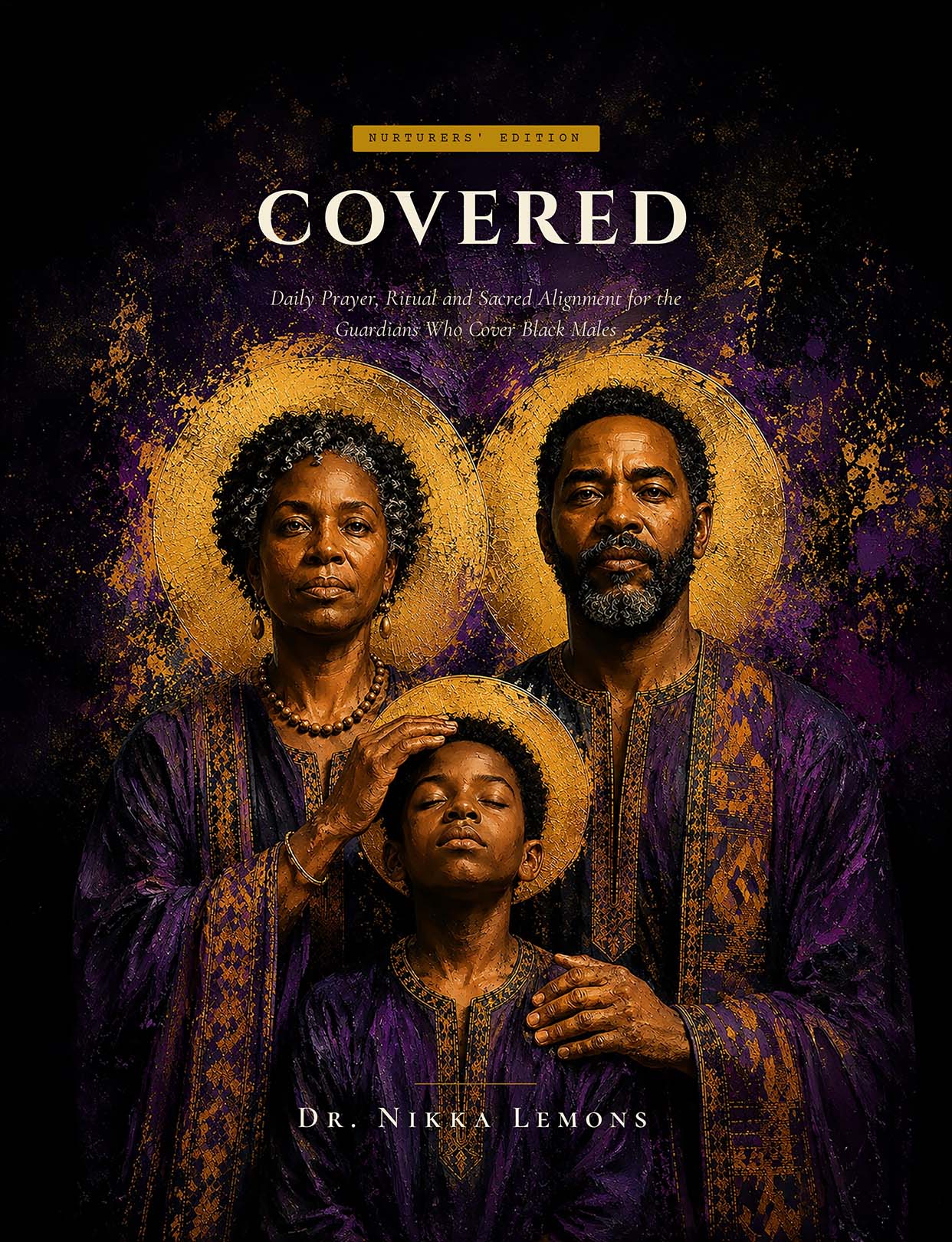

Cover painting
in preparation
Start the Conversation
Ready to build
what comes next?
Consulting, a platform implementation or a room to speak in. The work starts here.